
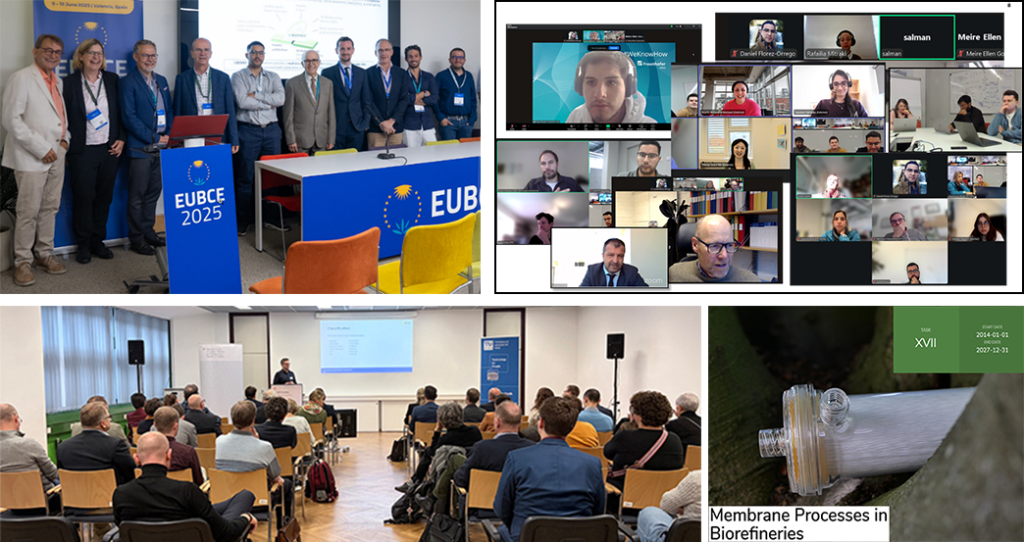
Looking Back on a Succesful Year
In 2025, there were more ongoing IETS Task than ever. And they were all busy either starting up, accelerating their work or concluding current Subtasks. Three of the Task Managers and one Subtask Coordinator have volunteered to share som insights from their work in 2025 – and look ahead into 2026:
Task XVIII – Digitalization, Artificial Intelligence and Related Technologies for Energy Efficiency and GHG Emissions Reduction in Industry, which has been in operation since 2018. The current Subtask, AI Methods in Industrial Energy Systems, which started early 2025 and will be concluded by the end of 2026, is coordinated by Florian Müller, TUWien, Austria.
Frank Lipnizki, Sweden, is the Task Manager of Task XVII – Membrane Processes in Biorefineries, which has been in operation since 2014. The current Subtasks started in 2024 and will be concluded by the end of 2027.
Simon Moser, Austria, is the Task Manager of Task XXI – Net-zero Industrial Processes in a Circular Economy Framework, which has been in operations since 2021. The current two Subtasks – Carbon Dioxide Capture in Industry and Facilitation of Industrial Symbiosis – started early 2025 and will be concluded by the end of 2026.
Daniel Florez-Orrego, Switzerland, is the Co-Manager of Task XXIV – Process Integration for Industry Decarbonization, which is our most recently started Task, which will run from Januar 2025 until December 2027.
They will all respond to the same three questions:
Florian Müller
1. What has been the most rewarding in your SubTask work during 2025?
The most rewarding aspect in 2025 has been shaping the foundations of the new Subtask 4 on AI Methods in Industrial Energy Systems. The kick-off in May 2025 and the first activity-related event — the Applied Energy Symposium panel in Västerås — marked important milestones, bringing together academic, industrial, and cross-task perspectives to identify shared challenges and future directions for AI in energy systems.
2. What has been the biggest challenge?
A key challenge has been stepping into the subtask coordinator role late in the year without knowing the consortium while building continuity from the work of my predecessor.
3. What do you look forward to (or hope for) the most for 2026?
I look forward to getting to know interesting people and projects related to AI for energy systems.
Frank Lipnizki
1. What has been the most rewarding in your Task work during 2025?
The most rewarding aspect of the Task work in 2025 has been the growth and collaboration within our network. We welcomed five new members—B4C, Vandstrom, and BOLLFILTER from Denmark, Technical University Vienna from Austria, and EMI Twente from the Netherlands. Hosting two workshop meetings was a highlight, where four of these new members presented themselves. Additionally, we benefited from an excellent update on research at the Technical University of Denmark (DTU) from Prof. Wenjing (Angela) Zhang and inspiring visiting lectures by Prof. Sabu Thomas (Mahatma Gandhi University, India) and Prof. Marwa Shalaby (National Research Center, Egypt).
A further significant achievement in 2025 was the publication of Membranes in Biorefineries: Guideline 3.0 – Guideline for the integration of emerging membrane separation processes in biorefineries for research, industry and decision‑makers, prepared and published by AEE (Austria). This new edition provides updated guidance and supports broader adoption of membrane technologies across biorefinery applications.
Together, these developments have strengthened our Task, expanded our expertise, and enhanced technical dialogue — making 2025 a rewarding and impactful year.
2. What has been the biggest challenge?
Strengthening collaborations with other tasks is a key priority. We are on the right track to achieve even more in the coming year.
3. What do you look forward to (or hope for) the most for 2026?
The Online Workshop “Membranes in Biorefineries” on March 19, organized by AEE in Austria, will be a real highlight—with great lectures and PhD student pitches. I’m also excited about promoting our Task during the plenary session at Membranes for Decarbonization and Sustainability (MDCS) and the 2nd Conference on Applied Membrane Technology and Translational Research in Mumbai, February 12–14. And of course, continuing to attract new members and strengthen collaboration around the latest research.
Simon Moser
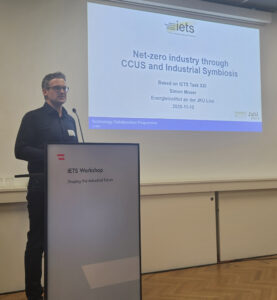
Simon Moser at an IETS Workshop in Vienna, Austria, in November 2025.
1. What has been the most rewarding in your Task work during 2025?
The most rewarding milestone in 2025 was the highly successful kick-off meeting on 17 March 2025, which brought together 18 participants from 7 countries and a total of 14 organisations. The event enabled excellent international exchange, created a very positive atmosphere, and generated motivation for the two parallel Subtasks moving forward.
2. What has been the biggest challenge?
One of the main challenges has been coordinating the participation of the various partners in the planned workshops. Since we agreed to elaborate on the two Subtasks’ Activities in a workshop format, bringing together colleagues from different organisations and countries has required careful scheduling and flexibility. Nonetheless, the collaborative spirit has helped us make good progress.
3. What do you look forward to (or hope for) the most for 2026? (Professionally and/or personally.)
For 2026, we look forward to continuing the good collaboration within the consortium, advancing the work plan we have set out, and achieving visible progress. We also hope for more opportunities to exchange ideas across countries. In particular, we are excited about next year’s in-person workshop in Graz/Austria, as personal interaction is highly valued and helps us work together even more effectively.
Daniel Florez-Orrego
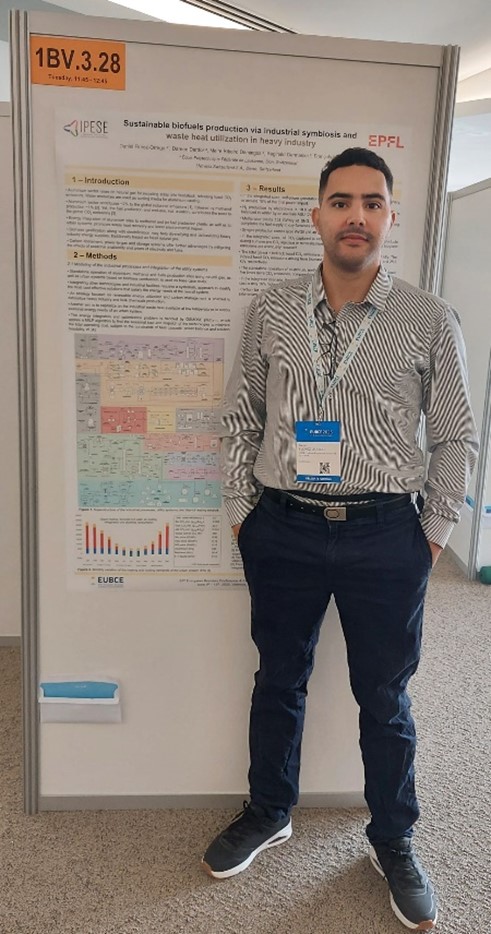
Daniel Florez Orrego at the 33rd European Biomass Conference and Exhibition (EUBC E2025) in Valencia, Spain in June, presenting “Sustainable Biofuels Production via Industrial Symbiosis and Waste Heat Utilization in Heavy Industry”.
1. What has been the most rewarding in your Task work during 2025?
The most rewarding aspect has been establishing genuine international collaboration through trust-building and shared understanding. Transforming the abstract concept of a “shared model database” into concrete frameworks through bilateral meetings, surveys, and the first in-person workshop in Lisbon demonstrated that meaningful cooperation across 10+ countries is possible when concerns about intellectual property, confidentiality, and citation are addressed trans-parently. Seeing participants move from cautious skepticism about model sharing to actively proposing layered access frameworks and validation protocols showed that the Task is creat-ing something valuable, not just another repository, but a living collaborative ecosystem. The recognition from the Swiss Federal Office of Energy that our frameworks serve as reference standards, combined with the successful co-organization of the industrial symbiosis workshop with Task XI, validated that process integration methodologies can bridge academic rigor with practical industrial needs while fostering knowledge transfer that accelerates decarbonization action.
2. What has been the biggest challenge?
The biggest challenge has been navigating the fundamental tension between transparency requirements for reproducible science and legitimate intellectual property protection concerns across diverse institutional and national contexts. Different countries have different legal frameworks, different relationships between academia and industry, different cultural norms around data sharing, and different risk tolerances regarding proprietary information. Some participants work primarily with licensed software that constrains sharing; others emphasize that maximum detail sharing is essential for validation; still others propose layered access mechanisms where detailed models are provided “on demand.” Reconciling these perspectives while designing a template that accommodates linear programming, nonlinear optimization, metaheu-ristic approaches, sequential modular structures, and equation-oriented paradigms, all while maintaining the physical consistency needed for meaningful process integration analyses, re-quired diplomatic engagement and technical iteration. The survey design itself became a peda-gogical tool to help participants understand the “rules of the game” by answering questions about their own practices, but ensuring all voices were heard equitably across language barriers and time zones demanded continuous attention to inclusive communication practices.
3. What do you look forward to (or hope for) the most for 2026?
We look forward to transitioning from framework establishment to demonstrated impact through implemented case studies that validate the Task’s approach. Seeing the first shared models actually being used by other countries to inform their decarbonization strategies, ob-serving cross-country model comparisons that reveal new optimization opportunities, and doc-umenting how the database enables faster technology assessment would confirm that the in-tensive coordination work of 2025 created lasting value. The continuation of the Chablais regional decarbonization